First and foremost I am a movie fan. I care that old movies and great television are preserved and remain available for viewing for future generations.
I think it’s a little sad that we have lost, perhaps forever, Hitchcock’s 1926 silent film The Mountain Eagle for example, or we no longer have available to us Orson Welles’ original cut of The Magnificent Ambersons. This year I spent a bit of time exploring films starring the absolutely wonderful Jean Arthur — and it is a little disconsolate that many of her early movies are on the long list of lost films.
So I have always had a respect for the work of the archivists and restorers who work at places such as the Academy Collection, British Film Institute and Sherman Grinberg (and many others around the world) who do their best to protect and in many cases rescue our collected film and television memory.
But it is also fair to say that, until the last couple of weeks, I had not thought too intensely about the challenge they face.
[CUT TO:]
One of the requirements of the festival submission process is to prepare biographies for the people involved as part of an information pack. As Something Pointless is preparing for its film festival run, this activity has been happening behind the scenes in the last few weeks.
The preparation of my mini-biography came with a reasonable request, to what on the surface seemed like a simple ask — to update my IMDb profile. Now there was probably a time (10 years ago!), that I could have just listed all the cast and crew involved in my early and formative attempts at film-making from memory. But sadly my hippocampus is not quite as fine tuned as it once was — so it led me to the back of the cupboard to retrieve my old films to access the relevant information.
And that is when the challenge of movie archiving became deeply apparent to me!
My pre-conceived notion of film archives is it is full of patient and precise craftsmen and women who spend their time in white gloves, tweezers in hand, carefully restoring celluloid and nitrate prints. In my mind, it is an activity largely focused on the early 20th century media — namely film prints. I had rather naively assumed that once we moved into the video and digital period, most of the world’s media would be protected and readily available.
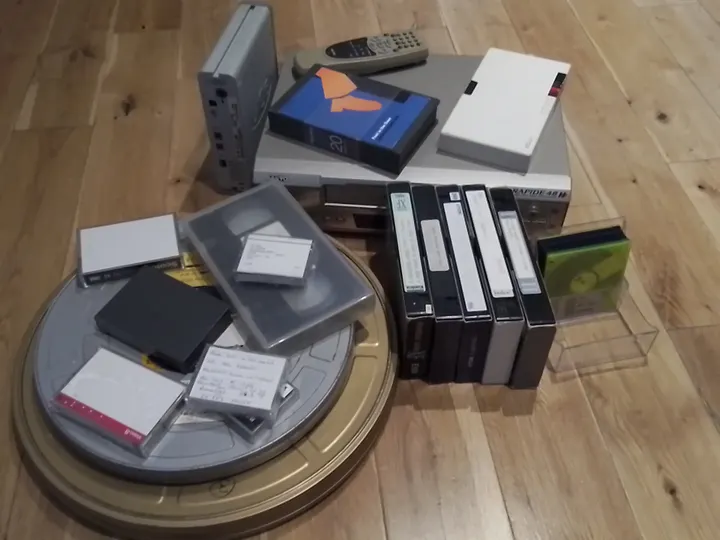
I am not a hoarder. I live in London: floor space is expensive! But I do still have copies and some electronically stored production files of the short films I made in the 1990s. But sadly the video formats they were stored in (VHS, Hi-8, Digi Betacam) are not that easy to access these days. I was fully prepared for the challenge of how to access 16mm or Super-8 prints (I have both) — but accessing my video and digital archive was unexpectedly a challenge!
Remarkably, I still have a functioning VHS player — but hooking it up to my modern television — with no Scart connection, was not straightforward. After a couple of attempts and some Wallace and Gromit style cabling, there was success when an old student film flickered (and it really did flicker!) into life on the screen: an oddly satisfying experience. But mysteriously, some other VHS copies would only play sound — no image at all. A mildly engaging experience to be sure — listening to, if not seeing, a film I have not looked at for 25 years — but absolutely not helpful when trying to read the credits!