FAQ

the blog.

2025 > The Art of the Start

The Art of the Start

By Neil Graham

04 Dec 2025

© Alien, Dir. Ridley Scorr, 20th Century Fox, 1979, All rights reserved

There are so many wonderful opening lines to novels. You probably have your own favourite. “Call me Ishmael”, “It was the best of times, it was the worst of times” or “It is a truth universally acknowledged, that a single man in possession of a good fortune, must be in want of a good wife.” — I love that last one so much — it is perfectly sublime and I still have not read Pride and Prejudice! But it instantly sucks you in with its humour whilst succinctly hinting about what this book will be about, plot wise — grabbing yourself a rich husband.

Whilst ploughing through my old boxes of film stuff in search of the full cast and crew lists who had worked on my previous films for our Something Pointless festival submission pack, I came across some feature film screenplays on old floppy disks. I couldn’t resist a little browse through them. Reading screenplays is a great way to learn about this craft, and scripts generally take less time to read than Melville, Dickens or Austen novels — which is a useful feature if like me to tend to be a little time impoverished 🙂

So it was fun to have a quick scoot through some of the established classics of the screenplay world: Blade RunnerChinatownThe Big Lebowski and Alien amongst many others. All are great reads in their own right.

But writing for a novel and writing for a film do have some subtle and important differences. Namely that novels are close to the finished article once the writer is content with the words on the page — but scripts are generally just the starting point of an ongoing creative process. One of the more interesting facets of reading screenplays for films that make it all the way to production — particularly if you can get hold of early drafts and non-shooting scripts, is that they are often different, sometimes significantly, from what you actually end up seeing on the screen.

It is just the beginning….

The Alien screenplay is an established classic. It is still featured today on many a screenwriting class. Like the space creature itself it is a perfectly evolved specimen. It is lean and mean with limited dialogue. If you have read it, it is probably the revised final Walter Hill and David Giler version of Dan O’Bannon’s original. It is widely available online.

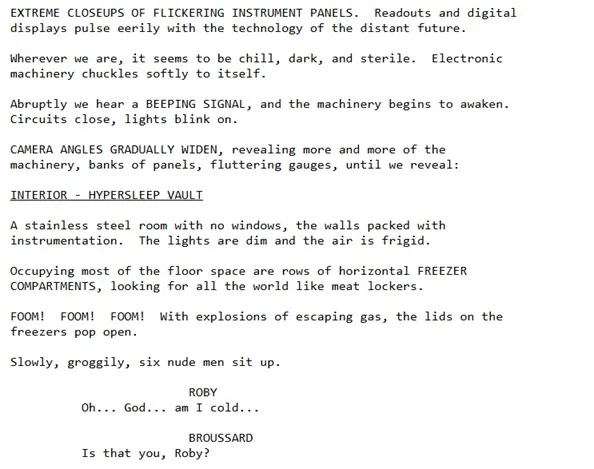
Here are the opening few lines:

Screenplay by Walter Hill & David Giler © 1978

See how visual the writing is. No dialogue on page one. Just simple sparse descriptions. Aesthetically, the page itself is interesting. All that blank space. The script is almost haiku like in appearance. And it is so quick to read….. By the bottom of the page you are hooked and keen to carry on to page 2. And that for me is always a positive sign of good writing in any medium — do you want to simply read “just one more page….” before you give up for the night. Alien is one of those scripts that is hard to put down.

The start is great, and generally you do want to try and pull the reader (whether that is a potential producer or an initial reader of a spec. script) into your fictional world as quickly as possible.

But there were several drafts created by Dan O’Bannon & Ronald Shusett before it got to Hill and Giler. Here is the first page of the original:

Screenplay by Dan O’Bannon © 1976

I don’t think it is quite as good as the later version. It does not quite build the atmosphere and pace as efficiently as the later version — it is more descriptive and dialogue heavy. But it is still really good. It is mysterious and involving. The central concept is still fabulous: Jaws in Space. You still want to keep reading and get to the next page, find out what happens next. It’s not quite as speedy a read, but it’s still a great read. You can really appreciate why it got the attention of a team who wanted to spend a proportion of their lives turning it into a movie. The written words still suck you in to the mysterious futuristic world on the spaceship and to the horrifying plight of these characters.

And on top of that the final film — the version you see on screen is different too. Scott’s film starts outside the spaceship with the Nostromo drifting through the blackness, before we are shown the empty interior. And new details are added before the ship’s computer brings the crew to life — the rustling newspaper, for example establishes there are people on this ship — before further details of their predicament is introduced. And that’s before you get to the enhancements brought by the great art design, fluid camera movement and Jerry Goldsmith score. Film writing is by its nature a collaborative and evolving process.

I was lucky enough to attend the recent screening of Twinless at this year’s London Film Festival. In his introduction, James Sweeney (who also directed and stars in the film) talked about how he felt he wrote the film three times. Firstly as a script that described the film James had in his head; it was then written again whilst filming (and he does describe this process in terms of writing) as all his cast and crew and circumstance shaped and altered the tone of the material; and finally again during the editing phase when the material is again re-written to ensure clarity of story, character and consistent pacing.

I think this is a great way to thinking about writing for film. As the process from first script to screen will almost certainly change over time. The screenplay is just the start.

I am aware in writing this, that Something Pointless will soon be completed and released. And yes we are all very excited to share it with the world in 2026! But particularly, I’m looking forward to discovering what the amazing talent, in front and behind of the camera, have brought to the initial script. The act of re-writing those initial ideas formed several years ago into what is now the final movie.

Chances are, if you are reading this blog you have written your own short script and you are about to submit to the CSSC. You are perhaps beginning your own little journey to seeing it produced and viewed on the big screen one day. How you start a script, particularly a short script is of course important. You only have 10–15 pages to tell your narrative. But there are no definitive templates. Provide descriptions, don’t provide them. Lots of dialogue, no dialogue. It really does come down to how compelling is the concept and story and the characters you create to tell it. The first and last version of the Alien screenplay (and all those in between) share this in common.

If you have a killer first line on par with Jane Austen then put it in there! But also don’t sweat the small stuff. Focus on your characters and story. And for those writers who make it into development, almost certainly, the script will change over time. That’s the joy of this collaborative world of film. The script is the art in the start……

Don’t forget the early bird deadline is December 28th. And remember to go back for the cat…..
Submissions are open for the 7th annual Canadian Short Screenplay Competition.

The Early Bird Deadline is December 28th, 2025. The final deadline is April 26th, 2026. Get your entries in via FilmFreeway or also now courtesy of the fine folks over at Stage32, if you’re feeling so inclined to share your latest work.

Written by Neil Graham

2025 #WW Laureate

SHORT. IS. BETTER.
Join the email list